
Start a Macomb Property Search
Start any Macomb County property search with the parcel itself. Guessing which office holds every answer wastes time. Macomb has no countywide assessor for all land. Each of the county's 27 cities, villages, and townships keeps its own assessment roll, and County Equalization ties those rolls together through BSA Online. The county Parcel Explorer returns the Tax ID, community, address, legal description, and a path to local tax data. The Clerk/Register of Deeds then confirms recorded instruments. Save every source and its date. A deed may be newer than the local roll. A mailing address may differ from the property address. A GIS polygon is only a map reference, so treat those gaps as clues rather than errors to erase.
- Search BSA or Parcel Explorer with the street address and community.
- Copy the full Tax ID, situs address, owner field, and legal description.
- Search the deed index by owner, parcel, address, subdivision, or lot.
- Compare assessment and tax data with the local treasurer and county Treasurer.
- Check plats, permits, court files, or certified copies when the question requires them.
Who Keeps Macomb Property Records
Macomb County property records sit with different custodians. The Clerk/Register of Deeds records deeds, mortgages, assignments, discharges, liens, lis pendens, and plats. Local assessors keep the owner and value fields. The Treasurer handles delinquent taxes and foreclosure timing. County GIS maintains the spatial data, while court and probate records add context when litigation or an estate shaped a transfer. Ask the office that owns the specific record instead of treating one portal as a master file.
Macomb County Clerk/Register
120 N Main Street
Mount Clemens, MI 48043
586-469-7953
Local Assessors and Equalization
Assessment rolls are municipal
Countywide links are online
Use the parcel's local unit
Macomb BSA Search Keys
Three keys open local assessment and tax records in BSA. An address is the natural start. Municipal spelling quirks and street suffixes can scramble an otherwise good match. A name search can return several parcels. Check each hit against the situs address. Use the parcel number when known, since it is the cleanest link between offices.
| Lookup key | Visible entry | Best use |
|---|---|---|
| Address | Street number and name | Locate one known site |
| Name | Owner name, such as surname first | Find accounts linked to a name |
| Parcel Number | Macomb Tax ID pattern | Match the exact mapped parcel |
BSA labels its services for detailed records, bills, delinquent taxes, and delinquent-tax searches. Coverage and display fields still vary by local unit. When an owner or value looks stale, contact that assessor. The BSA landing screen shows all three modes. The county's own entry page helps identify the right starting tab before a local unit takes over.
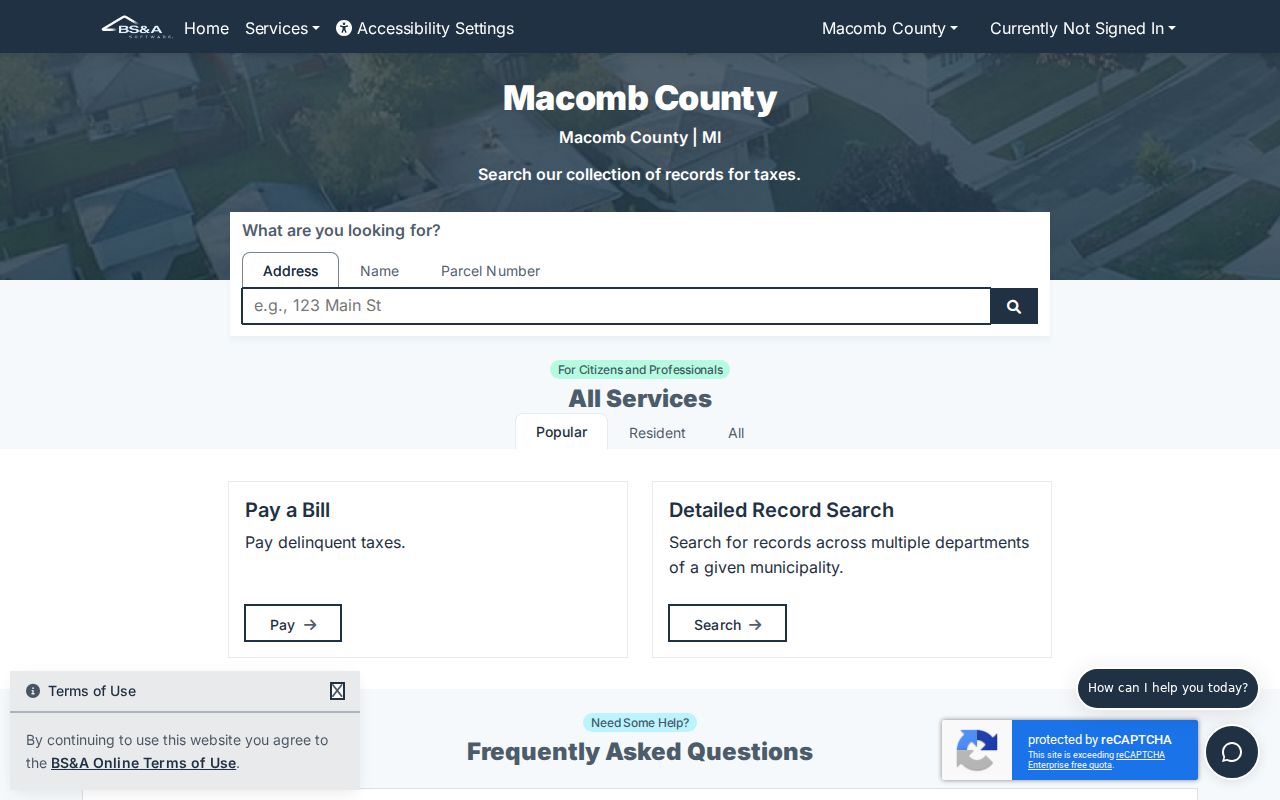
That screen links one parcel identity to tax and detailed-record services. It still cannot replace the recorded deed.
Macomb Parcel Explorer Tools
The Macomb County Parcel Explorer searches a full or partial Tax ID. It also handles property address, known address, or intersection. Its known-address points cover apartment, condominium, and mobile-home units. That quirk helps when the unit is real. The tax parcel may still cover a larger site. The county guide advises omitting street suffixes. Drop Road, Drive, Avenue, Boulevard, and Court from address searches. Selecting a parcel may expose Local Tax Assessing Data, the legal description, and a delinquent-tax route. Bird's Eye View and buffer controls may appear as well. Selection, measurement, print, image, and PDF tools make the map handy for a research file. Comma-delimited export tools do too. The polygon is still just a reference. A recorded plat, deed, easement, or licensed survey controls any legal boundary question. Map lines never settle a dispute on their own.
Macomb Property Record Sets
Different Macomb County property records answer different questions. A tax card is not a deed. A court docket is not a final transfer. The table pairs each chief record with its custodian and access path.
| Record | Question answered | Custodian | Route |
|---|---|---|---|
| Deed or land contract | Who conveyed an interest, and to whom | Clerk/Register of Deeds | Tyler index, office terminal, mail, copies |
| Assessment and tax roll | Administrative owner, SEV, taxable value, tax | Local assessor and treasurer | BSA or local office |
| Parcel and plat | Tax ID, mapped shape, lot, block, subdivision | County GIS and Register | Parcel Explorer, REST data, recorded plat |
| Lien or lis pendens | A recorded claim or notice affecting land | Register and courts | Land index, CourtView, Clerk file |
| Permit and zoning file | Approved work and land-use review | City or township | Municipal BSA, planning office, FOIA |
The Macomb County deed records route covers recorded instruments and copies. Tax fields, exemptions, and appeals belong with the property-tax record, not the deed index.
Macomb Deed Index Access
Macomb's public Tyler index opens with a disclaimer and a free index search. The basic form uses one name field, accepting last name, first name, and party variants. Advanced search adds parcel ID, house number, street, subdivision, lot, block, condominium, unit, building, legal description, and party names. County help offers a useful insider tip. Add an asterisk after the street name there. Images and downloads may sit behind a purchase or subscription. A single document costs $6. The county also sells $15 daily, $22.50 monthly, and $75 annual subscriptions with stated image limits, plus in-person public terminals. Staff or mail searches run $5 per search. Ordinary copies cost $1 per page. A certified copy adds $5, and these are access charges rather than the separate fee to record a new instrument. The Tyler public-search disclaimer must be accepted before searching. The entry screen is the county's own access gate, not a third-party index.
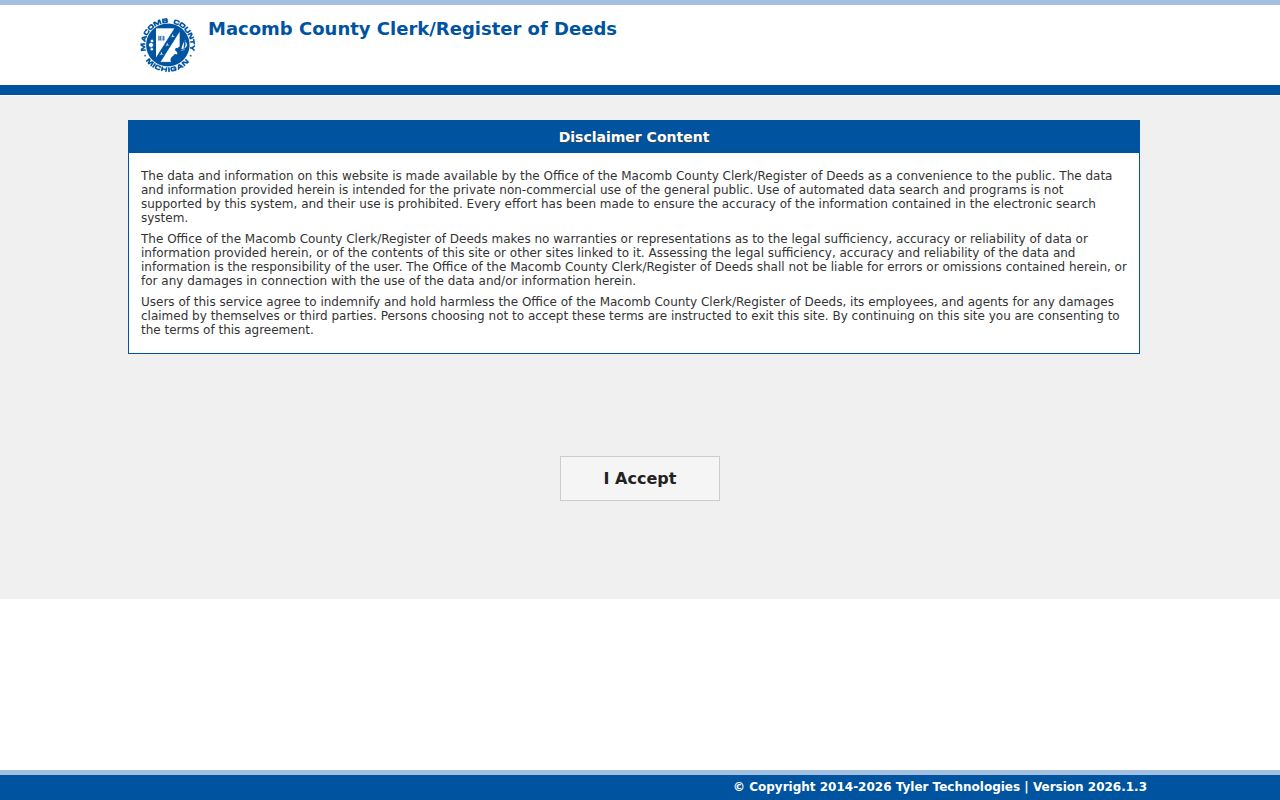
Accepting the terms opens the index. It does not certify that a result is complete or create a title opinion.
Macomb Values Need Labels
Michigan assessment language confuses people fast, so keep the labels straight. Assessed Value and State Equalized Value generally sit at half of true cash value. Taxable Value is different. It is the base that millage multiplies to produce the tax bill. Proposal A can cap it below SEV. After a property transfers, the taxable value may uncap the following year. The 2026 inflation-rate multiplier is 1.027, a dated figure that could change later.
Four useful record terms
Parcel or APN: the tax identifier a county assigns to a mapped piece of land. Grantor and grantee: the party conveying an interest and the party receiving it. Plat: a recorded subdivision map. Assessed value: an administrative tax value, not a sale appraisal.
For scale, the 2025 recommended county equalized total was $59,800,464,951 across real and personal property. That is a countywide number. It says nothing about one home's worth. For a property-specific answer, use the local parcel card and note its year.
Macomb Permits Stay Local
Permits and zoning stay municipal in Macomb County, held at the city or township level. Warren publishes assessment searches by owner, address, or parcel. It also links BSA permit rows to planning files for subdivisions, lot splits, site condominiums, and zoning. Sterling Heights runs a 24-hour permit and code search by address or parcel, though formal site plans and zoning material may require a City Clerk FOIA request. St. Clair Shores connects building permits by property. It adds zoning maps, BSA information, and 20 years of assessment rolls.
That split explains why the three largest cities keep separate records pages. Warren's inland auto-era street grid, Sterling Heights' township-to-city growth, and St. Clair Shores' canal-and-shoreline geography each create different search problems. A ZIP code alone proves nothing about jurisdiction. Confirm the community field in county GIS first, then open the matching municipal portal.
Each city's trail holds different evidence. Warren Planning reviews subdivision plats, site condominiums, lot splits and combinations, site plans, special land uses, rezonings, and vacations. Its Village Historic District can push an exterior-work decision into Historic District Commission records alongside the permit file. Sterling Heights groups Building, Flood, Neighborhood, and Planning functions under Development Services. The city no longer issues zoning-verification letters. Formal site-plan or permit material now goes through the City Clerk records-request route. St. Clair Shores tracks building, plumbing, mechanical, electrical, fence, and driveway permits. Property lookups are gathered in one city menu. None of that replaces the county deed. The deed records still carry the ownership evidence.
Municipal files show what was approved and built. The county recorder shows who holds title.
Macomb Deeds Reach to 1818
Macomb County was organized from Wayne County in 1818. An official technology case study says the county's SuperIndex reaches back to that formation year. The live portal publishes no earliest searchable year. The distinction matters. Deep historical reach never promises free online images for every old instrument.
The FamilySearch Macomb catalog lists deed books from 1801 through 1901 and general indexes from 1799 through 1920. That collection bridges gaps when Tyler returns nothing for an old transfer. Archives of Michigan finding aids, Library of Michigan atlases and plats, and Mount Clemens Public Library directories and probate indexes help untangle old names and roads. Those are leads. The recorded deed and plat remain the property evidence.
Work the chain one transfer at a time. Start with the newest deed. Copy its grantor, grantee, recording date, instrument type, liber and page or instrument number, and full legal description. Then search that grantor as a grantee on an earlier conveyance. Repeat while the land description holds steady. If a lot was split or combined, move to the parent description and the recorded plat instead of forcing a modern Tax ID into an older book. Mortgages and discharges explain financing but are not ordinary conveyances. Probate indexes, directories, obituaries, and newspapers can settle identity questions when an estate or old spelling breaks the chain. Even so, every human-history lead still needs a recorded instrument behind it for property proof.
Macomb Fraud Guard Alerts
The Clerk/Register offers Fraud Guard for a subscribed name. A registrant enters and confirms an email address. The registrant accepts the acknowledgement. Notice then arrives whenever a document is recorded under that name. The alert can surface a new recording quickly. Name collisions can also trigger unrelated notices. Fraud Guard is not continuous title monitoring, and it blocks nothing.
The official Fraud Guard signup shows the email fields and the recorder contact. The enrollment ties to a name and email, not to a parcel lock.
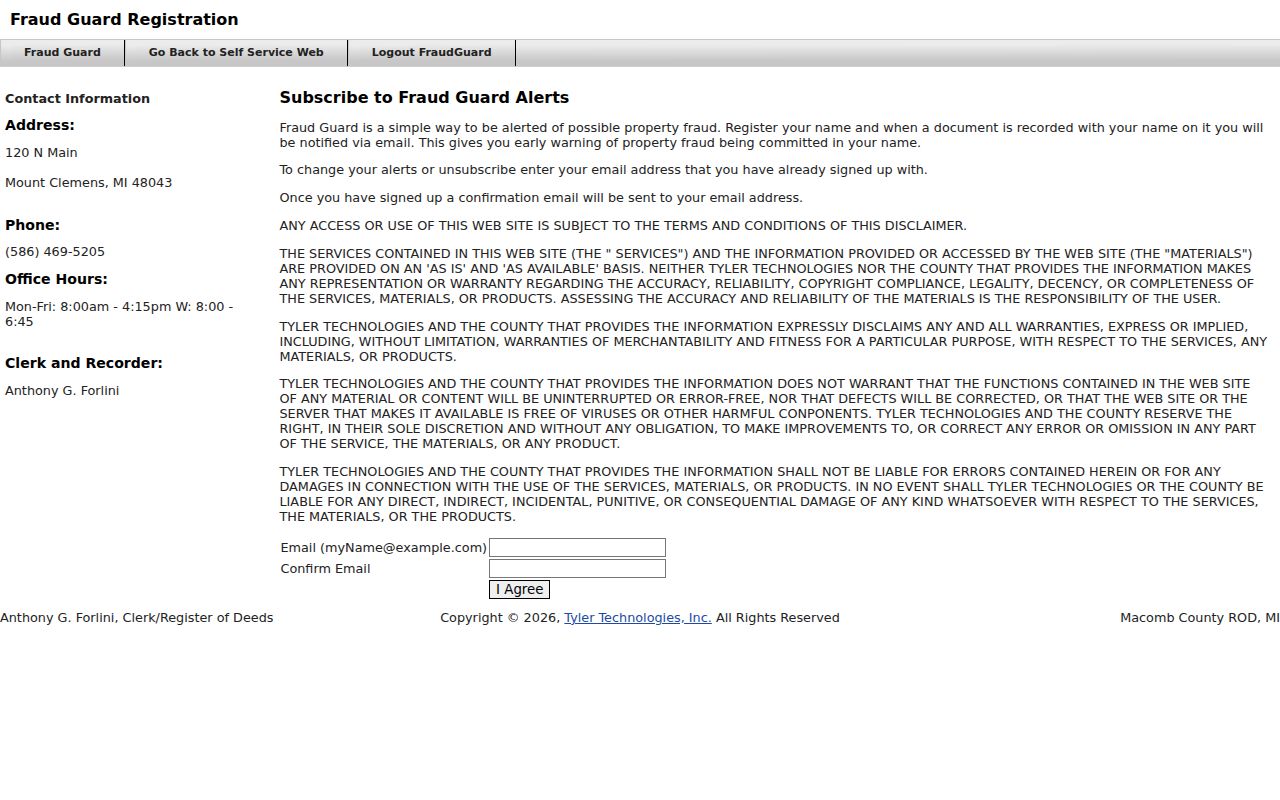
Note: Keep the confirmation email, and check any alert against the recorded document, parcel description, and parties before drawing a conclusion.
Macomb Courts Add Context
A property fight in Macomb County can leave tracks in several places at once. The 16th Judicial Circuit, the Probate Court, and the deed index may each hold a piece. CourtView gives public case-history access. The county calls it a convenience index. Always confirm against the Clerk's file. A lis pendens tells you litigation may touch the real estate. It says nothing about who won. Quiet-title, partition, lien, foreclosure, and boundary fights turn on the operative pleading, the order, the judgment, or the recorded instrument itself.
Clerk records can be requested online, by fax, by mail, or in person. Regular pleadings run $2 per page. Certification adds $10 plus $2 per page, and a name search costs $2 per name. For Probate, give the case number, the name in the matter, and your contact details. Fees are quoted before anything is delivered. Estate authority plus a death record can explain why a transfer happened. The recorded deed or affidavit still stands as its own link in the chain.
Foreclosure paper scatters across offices, too. The Register records sheriff's and clerk's deeds. A notice of sale runs in print for four straight weeks before auction. A notice reports a scheduled event, not a finished transfer. Treasurer files trace the three-year path of delinquency, forfeiture, and foreclosure for unpaid real property taxes. When one property surfaces in several systems, line up the parcel description, case number, instrument number, and filing date. Add the final recorded deed to that list. That habit keeps a pending notice from being mistaken for a judgment. It also keeps a tax balance from being mistaken for a completed loss of title.
When Online Macomb Search Fails
A blank result deserves a better query, not a guess. Try name variants, a partial Tax ID, or the community filter. A street name without its suffix can work. The subdivision and lot are worth a try too. Check the situs against the mailing address. For old parcels, follow the legal description through a split, a combination, or a parent plat. Today's Tax ID may not have existed decades ago.
Macomb County offers public Register terminals and a real-estate mail search form. Older deed books can be traced through FamilySearch or archives. Historic assessment rolls, zoning files, old permits, and municipal board packets may need a targeted Michigan Freedom of Information Act request. A public body generally answers within five business days. It may take one extension of up to ten more. Name the office, describe the record well, and include contact information.
Limits on Macomb Property Records
Macomb County property records can identify plenty. They show an administrative owner, a deed grantee, tax values, recorded liens, plats, permits. Court activity appears too. They cannot, on their own, prove occupancy, beneficial ownership behind every entity, a legally surveyed boundary, or clear title. They also cannot tell what a parcel would sell for. A permit applicant, tax-mail recipient, business agent, or map label may not hold title at all.
Michigan's Address Confidentiality Program gives qualifying people a designated address. It also forwards their mail. The program does not erase every earlier public record. Careful research leans on parcel identifiers, dates, and custodians. It skips needless personal detail.
Use records lawfully. Verify title with qualified professionals and boundaries with a licensed surveyor; never use owner information to stalk, harass, or harm anyone.